
35 Poll Questions for Training Sessions
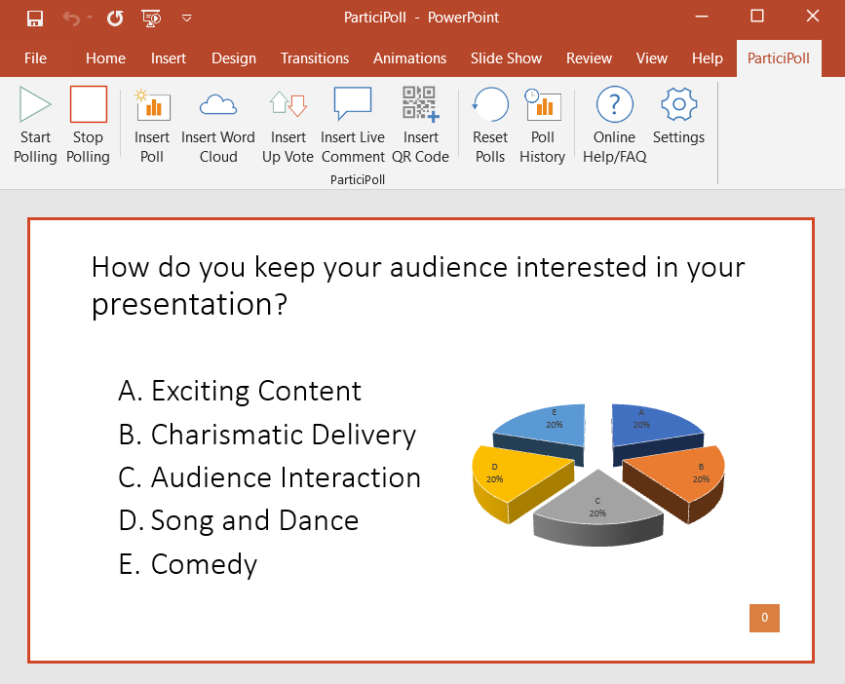
A useful training poll gives you something you can act on. It might reveal that your audience needs more background, uncover a misconception or help you decide which example to cover next.
The challenge is choosing questions that do more than fill a gap between slides.
Here are 35 poll questions for training sessions, organised by when to use them. Most include answer options you can copy into your presentation. Adapt the wording to your subject and audience, and choose a handful that will help you make decisions during the session.
Opening poll questions: get to know your audience
Start with a question that is easy to answer and relevant to the training. Use the results to acknowledge the experience in the room and explain how you will approach the session.
1. How familiar are you with today’s topic?
- Completely new to it
- I know a little
- I have some practical experience
- I use it regularly
Use this to check whether your planned introduction is at the right level. If experience varies widely, explain which parts will provide a foundation and where you will go into more depth.
2. How often do you currently use this skill?
- Every day
- Every week
- Occasionally
- Never
Familiarity and regular use are different things. This question helps you understand how closely to connect the training to participants’ everyday work.
3. How confident would you feel doing this without help?
- Not at all confident
- Slightly confident
- Fairly confident
- Very confident
Save this question and repeat it at the end. The comparison can start a useful conversation about confidence, although it does not demonstrate competence on its own.
4. What would you most like to get from this session?
- Understand the basics
- Improve how I do it now
- Solve a specific problem
- Help other people do it
Explain which expectations the session will address. If something falls outside its scope, say so early.
5. What is your biggest challenge with this topic?
- Knowing where to start
- Finding time to practise
- Handling difficult situations
- Knowing whether I am doing it correctly
Replace these options with obstacles relevant to your subject. Refer back to the results when you reach the corresponding examples.
6. Which part should we spend the most time on?
- The underlying principles
- A worked example
- Practical exercises
- Questions and discussion
Only offer choices you can accommodate. This works particularly well when you have some flexibility in the agenda.
7. In one word, how do you feel about today’s topic?
This is an open-text or word cloud question. Responses such as “curious”, “confused” or “sceptical” give you a starting point for acknowledging how people are approaching the session.
Avoid putting individuals on the spot by asking who submitted a particular word.
Knowledge-check poll questions
Knowledge checks are most useful when the answers tell you what to explain next. For subject-specific questions, prepare a correct answer and plausible alternatives based on common mistakes.
8. Which statement about [topic] is correct?
Provide one correct statement and two or three plausible misconceptions.
After voting, explain why the correct answer is right and why the alternatives might appear convincing.
9. What should happen first in this process?
List three or four real steps from the process you are teaching.
Use this to check whether participants understand the starting point before asking them to complete the whole task.
10. Which example best follows the guidance we have just covered?
Show three short examples, labelled A, B and C.
For example, a customer-service session could compare three responses to the same complaint. Ask participants to identify the relevant principle when discussing the answer.
11. Where is the mistake in this example?
- Step 1
- Step 2
- Step 3
- There is no mistake
Display a short worked example alongside the poll. Keep it brief enough for everyone to read before voting.
12. What information is missing before we can make a decision?
Offer several pieces of information, including the one that would most affect the decision.
This checks whether participants can recognise the limits of the information available.
13. How sure are you about your previous answer?
- I guessed
- I ruled out some options
- Fairly sure
- Very sure
Follow a knowledge question with this confidence check. An incorrect answer given confidently may need a different explanation from an uncertain guess.
14. Which part needs another explanation?
- The terminology
- The steps involved
- When to use it
- I am ready to move on
Make the options specific to the section you have just covered. Treat requests for clarification as useful information and adjust accordingly.
Scenario-based poll questions
Scenarios ask participants to apply what they have learned. Give everyone the same short situation, allow time to think, then use the results to explore their reasoning.
15. What would you do first in this situation?
Describe a realistic workplace situation and offer three or four possible actions.
Make clear whether there is a recommended first step or whether the aim is to compare reasonable approaches.
16. Which response would be most effective?
Present three possible responses to a customer, colleague or manager.
Keep the options realistic. If one is obviously absurd, participants can choose correctly without understanding the lesson.
17. What is the biggest risk in this scenario?
- Acting before checking the facts
- Delaying action
- Involving the wrong people
- Failing to record the decision
Adapt the options to the scenario. Ask what additional facts might change the answer.
18. Would you act now or seek advice first?
- Act now
- Seek advice first
- Gather more information first
Use the discussion to clarify decision-making authority, escalation points and the information people need.
19. Which additional fact would most change your decision?
Offer three or four new facts that could affect the scenario.
This helps move the discussion beyond choosing an answer towards understanding what the decision depends on.
20. What is the most likely consequence of this action?
Provide several plausible outcomes.
Ask participants to connect their choice to the principles covered in the training.
21. After hearing the discussion, which option would you choose now?
Repeat an earlier scenario poll after participants have discussed it in pairs or heard the reasoning behind different choices.
If the result changes, explore why. If it does not, check whether there are still unresolved questions.
Discussion and participation poll questions
These questions help you choose a useful direction for discussion. Where you ask for opinions or experiences, avoid treating the most popular answer as the correct one.
22. Which of these situations do you encounter most often?
List three or four situations relevant to the training.
Use the result to choose your next worked example.
23. Which approach would be hardest to put into practice?
List the approaches or techniques you have introduced.
Ask what makes the leading answer difficult, then discuss practical ways to address it.
24. How strongly do you agree with this statement?
- Strongly disagree
- Disagree
- Neither agree nor disagree
- Agree
- Strongly agree
Choose a statement that exposes a relevant assumption, such as “A complaint is only serious if the customer asks to speak to a manager.”
Explain whether you are exploring opinions or testing a claim that the training will address.
25. What would prevent this approach from working in your team?
- Lack of time
- Unclear responsibilities
- Missing tools or information
- Lack of support
- Nothing obvious
Use the answers to distinguish problems the training can address from issues that require organisational action.
26. Which question should we discuss next?
Summarise three or four questions raised during the session and let participants choose.
Acknowledge the remaining questions and explain whether you will return to them or follow up afterwards.
27. What is one thing people commonly misunderstand about this topic?
Use open-text responses to collect ideas.
Discuss a few examples and clarify any inaccurate claims before moving on.
Mid-session poll questions
Use these at a natural break to decide whether to change pace, revisit material or move into practice.
28. How is the pace of the session?
- Too slow
- About right
- Too fast
Explain what you can adjust. If responses are mixed, an optional recap or additional exercise may help.
29. What would help you most right now?
- Another explanation
- A worked example
- Time to practise
- Moving to the next topic
Use this when you have reached a point where several next steps would be reasonable.
30. Could you complete the task we have just covered?
- Independently
- With a checklist or guide
- With someone helping me
- I need it explained again
This is more specific than asking whether everyone understands. Follow it with a practical task where possible.
Closing poll questions: application and feedback
Leave enough time to respond to the final polls. The answers should help participants plan their next step and help you improve the next session.
31. Which technique are you most likely to use first?
List three or four techniques from the session, with an option for “I am not sure yet”.
Use the results to recap the most relevant resources or examples.
32. When will you next have an opportunity to apply this?
- Today
- This week
- This month
- I do not have an obvious opportunity yet
If people lack an opportunity to apply the learning, suggest a practice task or a conversation they could have with their manager.
33. What support would help you apply what you have learned?
- A checklist or quick reference
- More practice
- Feedback on my work
- A follow-up session
- No additional support needed
Only imply that support will be provided if you can deliver it. Otherwise, use the answers to inform recommendations.
34. How confident would you feel doing this without help now?
- Not at all confident
- Slightly confident
- Fairly confident
- Very confident
If you asked question 3 at the start, use the same wording and options so you can compare the results.
Discuss confidence alongside any practical exercises or knowledge checks.
35. What is one thing we should change for the next session?
Use an open-text response so participants can raise something you have not anticipated.
Ask for a specific change rather than general comments. Suggestions such as “allow more time for the exercise” are easier to act on than a simple satisfaction score.
How to choose the right polls for your training session
You do not need to use all 35 questions. Choose polls that serve a clear purpose within your session.
For a 60-minute session, a possible starting plan is:
- Opening: Check participants’ experience or priorities.
- After explaining a key idea: Test understanding.
- During practice: Ask participants to respond to a scenario.
- Before closing: Identify an action or support need.
Adjust this to the subject, group and time available. Allow for reading, voting and discussing the results, rather than treating the poll as an extra slide to rush through.
Keep each question focused on one thing. Include an “I don’t know”, “Not applicable” or “Other” option where people would otherwise have to give an inaccurate answer.
Be clear about anonymity, too. If responses are anonymous, avoid asking people to identify themselves afterwards, particularly when discussing mistakes or sensitive workplace experiences.
Most importantly, use what the audience tells you. Revisit a concept, choose a relevant example or explain why you are moving on. A poll earns its place when its result helps shape the training.
Use these questions in your PowerPoint presentation
ParticiPoll lets you run live audience polls within your existing PowerPoint slides, with participants responding on their own devices. You can also collect open-text responses using word clouds and live audience comments.
Choose a question from this list, adapt it to your training topic and add it to your presentation.
See the ParticiPoll getting-started guide for instructions, or try ParticiPoll before your next training session.